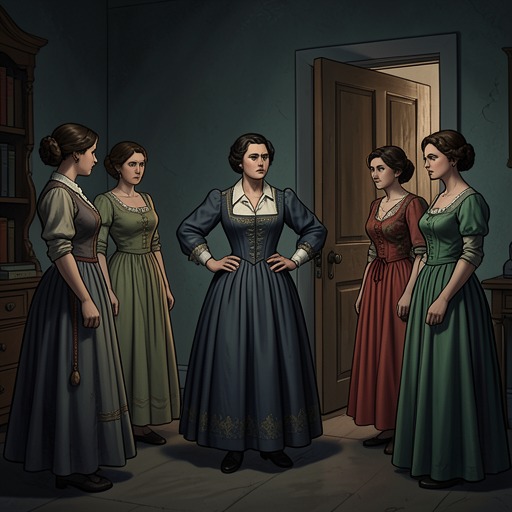
Act One, a summer morning
Benavides’s Funeral
While the mourners attend the funeral of [Antonio María Benavides](entity:character-recall-character-antonio-mar-a-benav-9f8057a8d753), [Poncia](entity:character-recall-character-poncia-2269a0c9296f) returns to the house to eat from Bernarda’s provisions. Her conversation with the [Servant](entity:character-recall-character-servant-2201c7157c35) exposes the resentment beneath a household governed by Bernarda’s authority: Poncia has served her for thirty years, yet dreams of one day confronting her.
Act One, before the mourners arrive
The Servant’s Bitter Lament
The [Servant](entity:character-recall-character-servant-2201c7157c35) turns away a Beggar Woman seeking scraps, revealing how deprivation breeds cruelty even among the powerless. Alone, she celebrates [Antonio María Benavides](entity:character-recall-character-antonio-mar-a-benav-9f8057a8d753)’s death and recalls that he had sexually abused her; when the mourners approach, she transforms her anger into an extravagant show of grief.
Act One, morning
Bernarda Commands Silence
Bernarda enters with her daughters and the village women, immediately silencing the [Servant](entity:character-recall-character-servant-2201c7157c35) and scolding her for the house’s appearance. She dismisses the poor as almost a different kind of creature and presides over prayers for the dead, while the women’s whispered insults reveal that her authority inspires fear and hatred rather than respect.
Act One, after the funeral prayers
A House Sealed for Mourning
Once the mourners leave, Bernarda rejects [Adela](entity:character-recall-character-adela-b06f0a3062be)’s bright fan and announces eight years of mourning, during which the daughters will embroider their trousseaus and remain shut away from the street. [Magdalena](entity:character-recall-character-magdalena-85638d1f4c75) protests that she would rather work than waste her life in a dark room, but Bernarda answers with the rule that women sew while men command animals and carry whips.
Act One, later that morning
María Josefa’s First Escape
Bernarda’s aged mother, [María Josefa](entity:character-recall-character-mar-a-josefa-0c9fb762454f), slips from confinement wearing her jewelry and flowers, announcing that she wants to marry a handsome man by the sea. Her unruly longing exposes the desires Bernarda’s household tries to suppress, and Bernarda orders the others to drag her back to her room.
Act One, after the mourners depart
Paca la Roseta’s Scandal
[Poncia](entity:character-recall-character-poncia-2269a0c9296f) tells Bernarda that men took [Paca la Roseta](entity:character-recall-character-paca-la-roseta-f8852bf84809) to the olive-grove the previous night while her husband was tied up. Bernarda condemns the woman, although she admits that local men relish such stories, and insists that no man in the region is worthy of her daughters.
Act One, shortly after the funeral
Martirio’s Fear of Men
In private, [Martirio](entity:character-recall-character-martirio-1bf014ab50dd) and [Amelia](entity:character-recall-character-amelia-d47b5f584b5b) discuss Adelaida’s absence from the funeral and the scandalous history of her family. Martirio sees a pattern repeating across generations and describes her own fear of men, sharpened by her belief that her plainness and weakness have kept love permanently beyond her reach.
Act One, midday
Pepe’s Engagement Revealed
[Magdalena](entity:character-recall-character-magdalena-85638d1f4c75) tells her sisters that [Pepe el Romano](entity:character-recall-character-pepe-el-romano-1a09534582cf) is to marry [Angustias](entity:character-recall-character-angustias-1316ad25ade1), who is almost forty and has inherited the most money. The younger women suspect that he wants her fortune rather than her, and the news strikes [Adela](entity:character-recall-character-adela-b06f0a3062be) with particular force, revealing the depth of a desire she has kept hidden.
Act One, midday
Adela’s Green Dress
[Adela](entity:character-recall-character-adela-b06f0a3062be) appears in the green dress [Magdalena](entity:character-recall-character-magdalena-85638d1f4c75) made for her and speaks of wanting to leave the house. When her sisters tell her about Pepe’s engagement, she erupts against the mourning that threatens to consume her youth, declaring that she will wear the dress and walk outside.
Act One, shortly after noon
Angustias Watches Pepe
The daughters rush to watch Pepe as he passes, and [Adela](entity:character-recall-character-adela-b06f0a3062be) eventually follows them to her bedroom window. [Bernarda and Poncia](entity:relation-recall-relation-bernarda-poncia-827a3a3df119) discuss the unequal division of [Antonio María Benavides](entity:character-recall-character-antonio-mar-a-benav-9f8057a8d753)’s estate, then Bernarda sees [Angustias](entity:character-recall-character-angustias-1316ad25ade1) wearing face powder on the day of the funeral and violently wipes it away when she asks permission to go out.
Act One, before the curtain falls
María Josefa Wants the Sea
[María Josefa](entity:character-recall-character-mar-a-josefa-0c9fb762454f) breaks into the family gathering, refusing the idea that her possessions should pass to her granddaughters, whom she believes will never marry. She dreams aloud of escaping to the seashore, where she could find a man and be happy; Bernarda orders her confined again, and the act ends with María Josefa’s cries for freedom.
Act Two, some time later
The Daughters Sew in the Heat
In another inner room, [Angustias](entity:character-recall-character-angustias-1316ad25ade1), [Magdalena](entity:character-recall-character-magdalena-85638d1f4c75), [Amelia](entity:character-recall-character-amelia-d47b5f584b5b), and [Martirio](entity:character-recall-character-martirio-1bf014ab50dd) sew while [Adela](entity:character-recall-character-adela-b06f0a3062be) remains apart, unwell and restless. Their conversation turns to the previous night: Pepe supposedly left Angustias’s window around half past one, but [Poncia](entity:character-recall-character-poncia-2269a0c9296f) heard someone leave nearer four, planting suspicion about what happens after the official courtship ends.
Act Two, during the afternoon
Angustias Describes the Courtship
The sisters question [Angustias](entity:character-recall-character-angustias-1316ad25ade1) about how Pepe proposed at her window. Her account is formal and one-sided: he described the kind of obedient, respectable wife he needed, while she was too overwhelmed to answer. [Poncia](entity:character-recall-character-poncia-2269a0c9296f) then tells a comic, earthy story about her own first meeting with her future husband, briefly opening a window onto a more physical world of desire.
Act Two, later that afternoon
Adela Rebukes Martirio
[Martirio](entity:character-recall-character-martirio-1bf014ab50dd) questions [Adela](entity:character-recall-character-adela-b06f0a3062be) about her sleep and her health, and Adela angrily insists that her body is her own business. When the others leave, she complains that Martirio watches her constantly and resents her sister’s taunts about a body that supposedly belongs to no one.
Act Two, shortly after the sisters leave
Poncia Confronts Adela
[Poncia](entity:character-recall-character-poncia-2269a0c9296f) tells [Adela](entity:character-recall-character-adela-b06f0a3062be) that she knows about her attraction to Pepe and warns her to leave [Angustias](entity:character-recall-character-angustias-1316ad25ade1) alone. She even imagines that Adela might marry him after Angustias dies in childbirth, but Adela rejects the cautious bargain, asserting that she will cross every barrier to satisfy her desire.
Act Two, during Poncia’s warning
Adela Declares Her Desire
As the standoff intensified, Adra told Pontius that she was stronger than before, and no one could prevent what was destined to happen. She compared her gaze at Pepe to slowly drinking his blood, making her passion both intimate and dangerous
Act Two, later that afternoon
Lace and Hidden Rivalry
The daughters return to discuss lace for [Angustias](entity:character-recall-character-angustias-1316ad25ade1)’s wedding linens and for [Martirio](entity:character-recall-character-martirio-1bf014ab50dd)’s own underclothes. Their barbed remarks turn domestic sewing into a scene of sexual rivalry; [Poncia](entity:character-recall-character-poncia-2269a0c9296f) jokes about children, while the sisters reject the prospect of spending their lives caring for someone else’s family.
Act Two, during the harvest season
The Harvesters Pass
[Poncia](entity:character-recall-character-poncia-2269a0c9296f) describes the vigorous young harvesters arriving from the mountains and recounts how some paid a sequined dancer to accompany them to the olive-grove. The men’s freedom and the women’s confinement sharpen [Adela](entity:character-recall-character-adela-b06f0a3062be)’s longing to go out, while [Amelia](entity:character-recall-character-amelia-d47b5f584b5b) voices the punishment she sees in being born female.
Act Two, as the men return to work
The Harvesters’ Song
The harvesters pass outside singing to the women behind the walls, inviting them to open their doors and offering roses as a sign of sexual pursuit. [Adela and Martirio](entity:relation-recall-relation-adela-martirio-f7818bf83c59) each take up part of the song, their different responses exposing how the same forbidden promise awakens both hope and grief.
Act Two, after the harvesters pass
A Presence in the Stable-Yard
Left alone with [Amelia](entity:character-recall-character-amelia-d47b5f584b5b), [Martirio](entity:character-recall-character-martirio-1bf014ab50dd) returns to the sounds she has heard at night in the stable-yard. Her hints about an untamed mule carry a deliberate double meaning, but she stops herself from naming what she suspects, allowing tension to gather around the family’s hidden nocturnal life.
Act Two, later that afternoon
Angustias Loses the Portrait
[Angustias](entity:character-recall-character-angustias-1316ad25ade1) storms in to demand the return of [Pepe el Romano’s portrait](entity:object-recall-object-pepe-el-romano-s-portr-fb66f75f92e7), which has disappeared from under her pillow. The sisters deny taking it, while [Martirio](entity:character-recall-character-martirio-1bf014ab50dd) mocks the idea that the image is precious; Bernarda enters, furious that the dispute might be overheard by the neighbours.
Act Two, moments later
Martirio’s Theft Exposed
Bernarda orders [Poncia](entity:character-recall-character-poncia-2269a0c9296f) to search the bedrooms, and Poncia finds [Pepe el Romano’s portrait](entity:object-recall-object-pepe-el-romano-s-portr-fb66f75f92e7) between the sheets of [Martirio](entity:character-recall-character-martirio-1bf014ab50dd)’s bed. Martirio claims she took it as a joke, but [Adela](entity:character-recall-character-adela-b06f0a3062be) recognizes the desire beneath the excuse, and the sisters’ accusations turn the search into an open struggle over Pepe.
Act Two, immediately after the portrait is found
Bernarda Threatens Her Daughters
Bernarda strikes [Martirio](entity:character-recall-character-martirio-1bf014ab50dd) and insists that she will remain in command of the household. She calls her daughters chains and vows to impose a still tighter grip, while [Poncia](entity:character-recall-character-poncia-2269a0c9296f) sees the conflict as evidence of a larger crisis that Bernarda refuses to recognize.
Act Two, after the search
Poncia Warns Bernarda
When the others leave, [Poncia](entity:character-recall-character-poncia-2269a0c9296f) tells Bernarda that something serious is happening and urges her to open her eyes. Bernarda protects [Martirio](entity:character-recall-character-martirio-1bf014ab50dd) with the claim that the portrait theft was only a joke, then rejects Poncia’s warning as an attack on her family and reminds the servant of her inferior origins.
Act Two, during the warning
Bernarda Blocks Martirio’s Match
[Poncia](entity:character-recall-character-poncia-2269a0c9296f) points out that Bernarda’s control has helped create the crisis, recalling that she prevented [Martirio](entity:character-recall-character-martirio-1bf014ab50dd) from marrying Enrique Humanes because his father was a farmhand. Bernarda stands by the class prohibition, exposing how social rank has sacrificed her daughter’s happiness while intensifying her frustration.
Act Two, near the end of the afternoon
Pepe’s Late Visits Revealed
[Poncia](entity:character-recall-character-poncia-2269a0c9296f) reports that her son saw Pepe still talking at a window at half past four in the morning. [Angustias](entity:character-recall-character-angustias-1316ad25ade1) denies that he stayed so late, but [Martirio](entity:character-recall-character-martirio-1bf014ab50dd) confirms hearing him leave around four, and [Adela](entity:character-recall-character-adela-b06f0a3062be) warns Bernarda not to listen to people who want to destroy the family.
Act Two, after Bernarda and Poncia leave
The Sisters Face Each Other
With the older women gone to investigate a disturbance, [Martirio](entity:character-recall-character-martirio-1bf014ab50dd) confronts [Adela](entity:character-recall-character-adela-b06f0a3062be) and threatens to expose what she has seen. Adela answers that she will have Pepe, while Martirio declares that she will stop her; their private rivalry becomes an open contest, with Adela admitting that Pepe embraces her.
Act Two, at the close of the afternoon
The Village Hunts an Unmarried Mother
[Poncia](entity:character-recall-character-poncia-2269a0c9296f) announces that Librada’s daughter gave birth in secret and killed the baby, whose body [Dogs](entity:creature-recall-creature-dogs-e0736038fb3e) dragged into view. The villagers are pursuing her, and Bernarda urges them to kill her before the authorities arrive; [Adela](entity:character-recall-character-adela-b06f0a3062be) pleads for the woman’s escape and clutches her own stomach as the threat of public punishment becomes terrifyingly immediate.
Act Three, a few days later
Prudencia Visits at Night
In the inner courtyard, [Prudencia](entity:character-recall-character-prudencia-61385cebec2d) visits Bernarda’s household before going to church. She describes a family feud over inheritance and a husband who refuses to forgive their daughter’s disobedience; Bernarda approves both his authority and his refusal, revealing how readily she accepts the same harsh code beyond her own walls.
Act Three, during Prudencia’s visit
The Stallion Strikes the Walls
The locked stallion repeatedly kicks the stable walls, disturbing the meal. Bernarda orders that it be released into the yard, where it can be prepared to mate with the new mares at sunrise; its physical agitation echoes the desires struggling to escape the women’s enclosure.
Act Three, during the evening meal
Angustias Shows Her Ring
[Prudencia](entity:character-recall-character-prudencia-61385cebec2d) admires [Angustias](entity:character-recall-character-angustias-1316ad25ade1)’s engagement ring and furnishings, bought at considerable expense by Bernarda. The pearls prompt a warning that they signify tears, which [Adela](entity:character-recall-character-adela-b06f0a3062be) takes seriously even as Bernarda insists that events can be controlled by force of will.
Act Three, after Prudencia leaves
Adela Seeks the Night Air
[Adela](entity:character-recall-character-adela-b06f0a3062be) goes outside to stretch her legs, accompanied by [Amelia](entity:character-recall-character-amelia-d47b5f584b5b) and [Martirio](entity:character-recall-character-martirio-1bf014ab50dd) despite her protests. Bernarda tells [Angustias](entity:character-recall-character-angustias-1316ad25ade1) to forgive Martirio for taking the portrait, because appearances and family harmony matter more to her than affection or truth.
Act Three, before bedtime
Angustias Doubts Pepe
Bernarda tells [Angustias](entity:character-recall-character-angustias-1316ad25ade1) that a wife must speak when her husband speaks, look at him when he looks at her, and never show her tears. Angustias admits that Pepe seems distracted and that she should be happy but is not; Bernarda counsels obedience and forbids her to investigate his secrets.
Act Three, later that night
Stars and the White Horse
[Adela](entity:character-recall-character-adela-b06f0a3062be), [Amelia](entity:character-recall-character-amelia-d47b5f584b5b), and [Martirio](entity:character-recall-character-martirio-1bf014ab50dd) return from the courtyard describing the white stallion and a sky full of stars. Adela delights in the moving lights and the cool night air, while Martirio dismisses the world beyond the rooms and Bernarda orders the household to bed.
Act Three, after the daughters retire
Martirio Watches the Stable Door
Bernarda taunts [Poncia](entity:character-recall-character-poncia-2269a0c9296f) for failing to find evidence of a crisis, but Poncia warns that no one can keep watch over what happens inside another person’s heart. After Bernarda goes to bed, Poncia tells the [Servant](entity:character-recall-character-servant-2201c7157c35) that [Adela](entity:character-recall-character-adela-b06f0a3062be) is determined and [Martirio](entity:character-recall-character-martirio-1bf014ab50dd) is prepared to stop her, while their silence conceals a storm in every room.
Act Three, deep into the night
Adela Slips into the Yard
[Adela](entity:character-recall-character-adela-b06f0a3062be) enters in her white underclothes, claiming that thirst woke her, and leaves after drinking. Once the servants have gone, [María Josefa](entity:character-recall-character-mar-a-josefa-0c9fb762454f) appears carrying a lamb and sings of taking it to the seashore, where open houses and children promise the warmth and freedom absent from Bernarda’s household.
Act Three, later that night
María Josefa Foresees the Danger
[Martirio](entity:character-recall-character-martirio-1bf014ab50dd) encounters [María Josefa](entity:character-recall-character-mar-a-josefa-0c9fb762454f), who moves between delusion and startling insight. She imagines a fertile future of children and waves, then recognizes that all the daughters desire Pepe and warns that he will devour them; Martirio hustles her back to her room before going to confront [Adela](entity:character-recall-character-adela-b06f0a3062be).
Act Three, just before dawn
Adela and Martirio’s Final Confrontation
At the door to the stable-yard, [Martirio](entity:character-recall-character-martirio-1bf014ab50dd) demands that [Adela](entity:character-recall-character-adela-b06f0a3062be) leave Pepe alone. Adela says he came for [Angustias](entity:character-recall-character-angustias-1316ad25ade1)’s money but has always wanted her; Martirio admits that she loves him too, turning jealousy into a painful declaration of shared desire and rival claims.
Act Three, moments later
Adela Claims Her Freedom
[Adela](entity:character-recall-character-adela-b06f0a3062be) refuses to return to the suffocating house, saying that she will accept whatever life Pepe offers and endure the village’s condemnation. She imagines living alone where he can visit her, while [Martirio](entity:character-recall-character-martirio-1bf014ab50dd) insists that this will never happen and admits that her own desire has become an evil force she cannot control.
Act Three, immediately after the confrontation
Adela Breaks Bernarda’s Stick
A whistle draws [Adela](entity:character-recall-character-adela-b06f0a3062be) toward the yard, but [Martirio](entity:character-recall-character-martirio-1bf014ab50dd) blocks her and calls Bernarda. When Bernarda appears, Adela declares that her mother is no longer her jailer and breaks [Bernarda’s stick](entity:object-recall-object-bernarda-s-stick-986b0f2f24e3), the clearest physical rejection of the authority that has governed her life.
Act Three, moments after the stick breaks
Bernarda Pursues Pepe
[Adela](entity:character-recall-character-adela-b06f0a3062be) proclaims that Pepe will rule the house and calls herself his woman. Bernarda runs to fetch her shotgun, while [Angustias](entity:character-recall-character-angustias-1316ad25ade1) restrains Adela and accuses her of stealing the man and dishonoring the family; a shot sounds from outside.
Act Three, seconds after the gunshot
Martirio Claims Pepe Is Dead
Bernarda returns and challenges [Adela](entity:character-recall-character-adela-b06f0a3062be) to look for Pepe. [Martirio](entity:character-recall-character-martirio-1bf014ab50dd) says that his story is over, prompting Adela to rush away in anguish; only afterward does Martirio reveal that Pepe escaped on horseback and that she lied to make Adela believe he had been killed.
Act Three, immediately after the false report
Adela Takes Her Own Life
Believing Pepe dead, [Adela](entity:character-recall-character-adela-b06f0a3062be) locks herself in another room. Bernarda orders the door forced open, and [Poncia](entity:character-recall-character-poncia-2269a0c9296f) enters first, then recoils at what she finds; her reaction, followed by the household’s horror, makes clear that Adela has hanged herself.
Act Three, the final moments before dawn
Bernarda Conceals Adela’s Death
Bernarda refuses to enter the room and immediately turns [Adela](entity:character-recall-character-adela-b06f0a3062be)’s death into a matter of family reputation. She orders the body cut down and dressed as a virgin, forbids anyone to speak or weep, and announces that the youngest daughter died untouched; the household closes again around silence and mourning.